Property manager resources
Practical guidance for scoping and budgeting exterior cleaning
Frequency recommendations by surface, what belongs in a scope of work, how commercial pricing actually gets built, and the questions worth asking any contractor before you award the job.
Frequency guide
How often commercial surfaces actually need cleaning
These are starting points. Tree cover, traffic volume, food service tenants and proximity to construction all shift the cycle.
| Surface or area | Typical cycle | Why |
|---|---|---|
| Restaurant dumpster pads and grease areas | Monthly | Grease accumulates fast, attracts pests and produces odor complaints. Monthly service is the standard for food service properties. |
| High-traffic retail sidewalks and entries | Monthly to quarterly | Gum, spills and traffic film build continuously at entrances and cart paths. Frequency tracks foot traffic volume. |
| Apartment breezeways and stairwells | Semiannual to annual | Covered corridors collect dirt, cobwebs and organic film. Semiannual keeps resident complaints down at properties with heavy tree cover. |
| Building exteriors and siding | Annual to every 2 years | Algae and mildew return on a predictable cycle in Georgia humidity. North-facing and shaded elevations need it sooner than the rest of the building. |
| Parking garages and decks | Annual, stairwells quarterly | Oil accumulation and airborne dust settle over a year. Stairwells and elevator lobbies need more frequent attention because of odor and appearance. |
| Loading docks and truck courts | Semiannual to annual | Hydraulic fluid, diesel and tire marking build steadily. Docks with high turn counts justify more frequent hot water service. |
| School campuses | Annual during summer break | The summer window allows a full-campus mobilization with no occupancy constraints, which is both cheaper and more thorough. |
| Office plazas and entry courtyards | Annual to semiannual | First impression surfaces for tenants and visitors, with pollen season in Metro Atlanta driving an extra spring cleaning at many properties. |
| Pool decks and amenity patios | Annual before season opening | Slip resistance and appearance both degrade over the off-season. Cleaning before opening avoids complaints in the first weeks of use. |
Scope of work checklist
What a complete commercial scope should specify
If a proposal is missing these, the comparison between bidders is not apples to apples.
- Every area included, identified by name and approximate square footage
- The cleaning method used on each surface — pressure, hot water or soft wash
- Chemicals or detergents used and any substrate restrictions
- Water source: property supplied or contractor supplied
- Runoff handling and any storm drain protection required
- Working hours and the sequence across buildings or levels
- Access requirements: keys, gates, elevators, garage levels
- Notification responsibilities for tenants or residents
- What is explicitly excluded from the scope
- Insurance certificate requirements and additional insured parties
- Walkthrough and acceptance process at completion
- Whether the price is one-time or part of a recurring schedule
Guides
Understanding commercial exterior cleaning
Pressure washing vs. soft washing — the distinction that protects your building
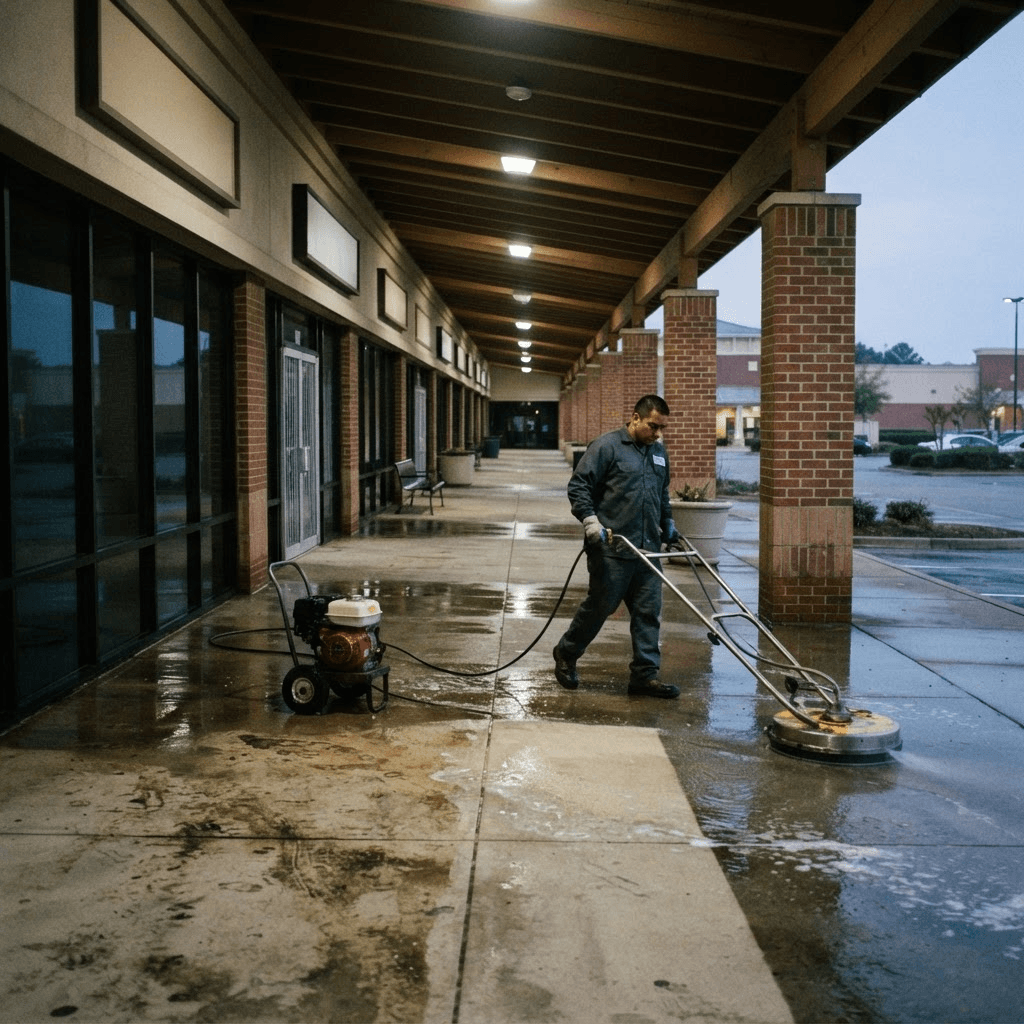
Pressure washing uses high water pressure to remove soiling mechanically. It is correct for hard, durable surfaces: concrete, masonry paving, industrial slabs, dock aprons and most parking structures.
Soft washing uses low pressure and cleaning solutions to break down organic growth chemically. It is correct for painted surfaces, stucco, EIFS, dryvit, wood, vinyl and composite siding, and for any facade where high pressure would drive water behind the cladding or strip the finish.
Using pressure where soft washing belongs is the single most common cause of exterior cleaning damage on commercial buildings. A qualified scope will say which method applies to which surface before the work is awarded.
Why commercial pricing cannot be quoted by phone alone
Two properties with identical square footage can differ in price by a wide margin. What drives that difference is substrate condition, the type of soiling present, water availability, drainage constraints, access limitations, elevation and how much of the site can be worked at one time.
A pad with three years of grease takes several times longer than one on a monthly cycle. A garage where water cannot be discharged to the storm system requires containment and recovery. A property that can only be worked between 11pm and 5am produces a different production rate than one available all day.
This is why site assessments exist, and why a number given over the phone without one is a guess that gets revised.
Budgeting exterior cleaning as maintenance, not as a repair
Recovery cleanings — properties that have gone years without service — cost substantially more per square foot than maintenance cleanings, because the soiling has bonded and requires more dwell time, more heat and more passes.
Property teams that budget a recurring cycle spend less over a three-year horizon than teams that wait for a complaint, an inspection or a lease-up deadline to force the work. It also spreads the cost across fiscal periods instead of landing as one large unplanned expense.
The practical approach is to identify the two or three areas that actually generate complaints, put those on a frequent cycle, and handle the rest annually.
Seasonal timing in Metro Atlanta
Spring brings pollen, which coats every horizontal surface and makes entrances and outdoor seating unusable-looking within days. Many properties schedule a post-pollen cleaning in late spring for exactly this reason.
Summer humidity accelerates algae and mildew on shaded elevations and north-facing walls. Fall brings leaf tannin staining on walkways and plaza concrete. Winter is generally workable in Georgia, though freezing conditions occasionally shift a night schedule.
Schools are the clearest case: summer break is the only window where a full campus can be cleaned without working around occupancy.
What to verify before hiring any commercial contractor
Confirm current general liability insurance with limits appropriate to your property, and require a certificate naming the owner and management company as needed. Confirm workers' compensation coverage.
Ask which surfaces will be soft washed rather than pressure washed, and how they intend to protect landscaping, light fixtures, signage and finished surfaces adjacent to the work.
Ask how water and runoff will be handled, particularly on garages, dumpster pads and any area draining to a storm inlet.
Ask for references on properties comparable in type and size to yours — multifamily experience does not automatically translate to structured parking, and vice versa.
Questions
Commercial exterior cleaning FAQs
How much does commercial pressure washing cost?
Commercial work is priced by surface area, condition, method required and access constraints, so there is no meaningful flat rate. What we can tell you is that maintenance cleaning costs less per square foot than recovery cleaning, and that recurring programs price better than one-off calls. Call us and we will walk the property before quoting.
Will pressure washing damage my building?
It can, if the wrong method is used. Stucco, EIFS, painted siding, aged mortar, wood and many coated surfaces must be soft washed at low pressure. Concrete, masonry paving and industrial surfaces tolerate pressure and heat. The scope should specify the method by surface before work starts.
Do you need water and power on site?
Water access on site is preferred and usually available. When it is not, we bring supply. Our equipment is self-powered, so building power is not required.
How do you handle runoff?
Runoff handling is part of the scope. On most concrete cleaning, water is directed and filtered appropriately for the site. On dumpster pads, garages and areas draining to storm inlets, containment and recovery are planned before the work begins.
Can cleaning happen while the property is occupied?
Yes — nearly all of our work is on occupied properties. The plan is what makes it possible: phased sequencing, night or early morning windows, advance notices, signage, and keeping entrances and parking accessible throughout.
Go deeper
Service and property detail
Want frequency guidance for your specific property?
Call (404) 313-8900. We will walk the site and tell you which areas need a schedule and which can wait — including the ones that do not need us at all.
Prefer email? Reach us at info@mwpressurewashing.com.